
15 Neighborhoods
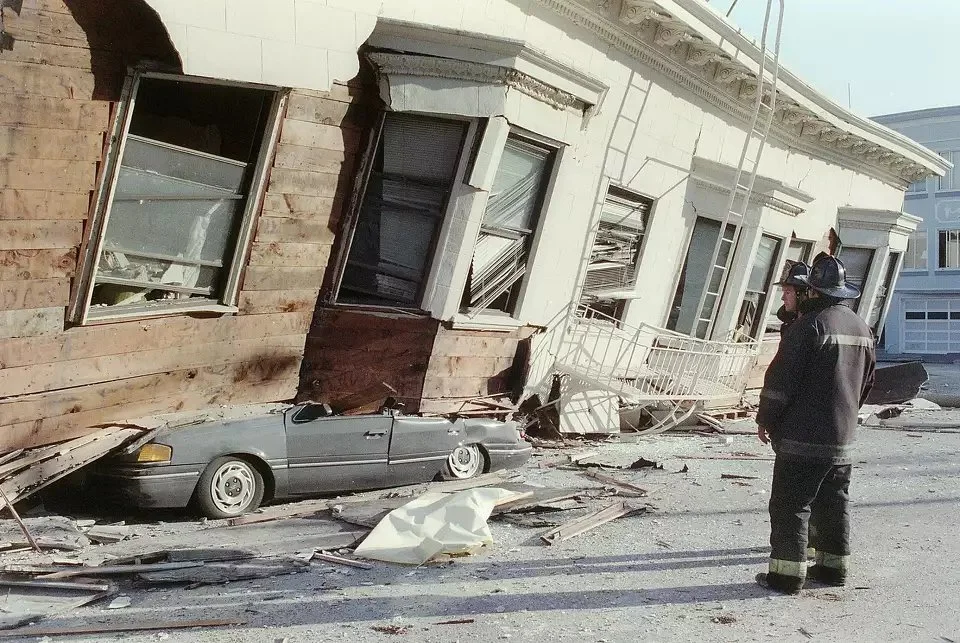
San Francisco’s Marina District, October 1989. A vehicle crushed under an apartment building that collapsed during the Loma Prieta earthquake.
Photo: Agence France-Presse/Adam Teitelbaum
Seawater vs. Drinking Water
AWSS Map
Map key
Red: Not covered by San Francisco’s AWSS (Auxiliary Water Supply System) firefighting seawater system.
Black: AWSS high-pressure water pipe.
Blue: San Francisco Supervisor district:
1 Richmond District
2 Marina District
3 North Beach
4 Sunset District
5 Haight-Ashbury
6 South Beach
7 Forest Hill, St. Francis Wood, Inner Sunset
8 Noe Valley
9 Mission District, Bernal Heights, Silver Terrace
10 Potrero Hill, Silver Terrace, Hunters Point
11 Ingleside, Crocker-Amazon
Pump Station: A building with machines that can pull seawater from the Pacific Ocean.
**Note: During a fire disaster, locations that are farther away from an AWSS pump station will have little or no access to firefighting seawater.
Today, only the east side of San Francisco is covered by the AWSS (Auxiliary Water Supply System) firefighting water system.
AWSS is a seismically safe water network that uses high-pressure fire hydrants and pump stations to supply an unlimited amount of seawater from the Pacific Ocean.
The system was built specifically for San Francisco in 1913, after the City’s drinking-water system failed during the 1906 earthquake.
AWSS is separate and distinct from San Francisco’s drinking-water system, which Mayor Daniel Lurie and City agencies alternately refer to as:
Emergency Firefighting Water System.
Potable Emergency Firefighting Water System (Potable means “safe to drink”).
Why Los Angeles burned
A drinking-water system is a fragile, low-pressure system that is not made to handle the volumes of water needed to fight a massive, out-of-control firestorm.
To extinguish a firestorm, the combustion sources need to be covered with enough high-pressure water to remove the heat.
During the 2025 Palisades Fire in Los Angeles, the city’s drinking-water system lost pressure three times. Local fire officials have said that the Los Angeles Fire Department was lucky to get it going the fourth time, or they likely would have lost the entire city of Los Angeles.
The Pacific Ocean is the only reliable source of unlimited, high-pressure water for coastal cities such as Los Angeles, Lahaina, and San Francisco.
No AWSS coverage
Bayview Heights
Crocker-Amazon
Excelsior
Ingleside
Little Hollywood
Merced Manor
Mission Terrace
Oceanview
Parkside
Portola
Richmond District, west of 12th Avenue
Sea Cliff
Stonestown
Sunnyside
Sunset District, west of 19th Avenue
Earthquake Fault Lines Vs. Drinking Water
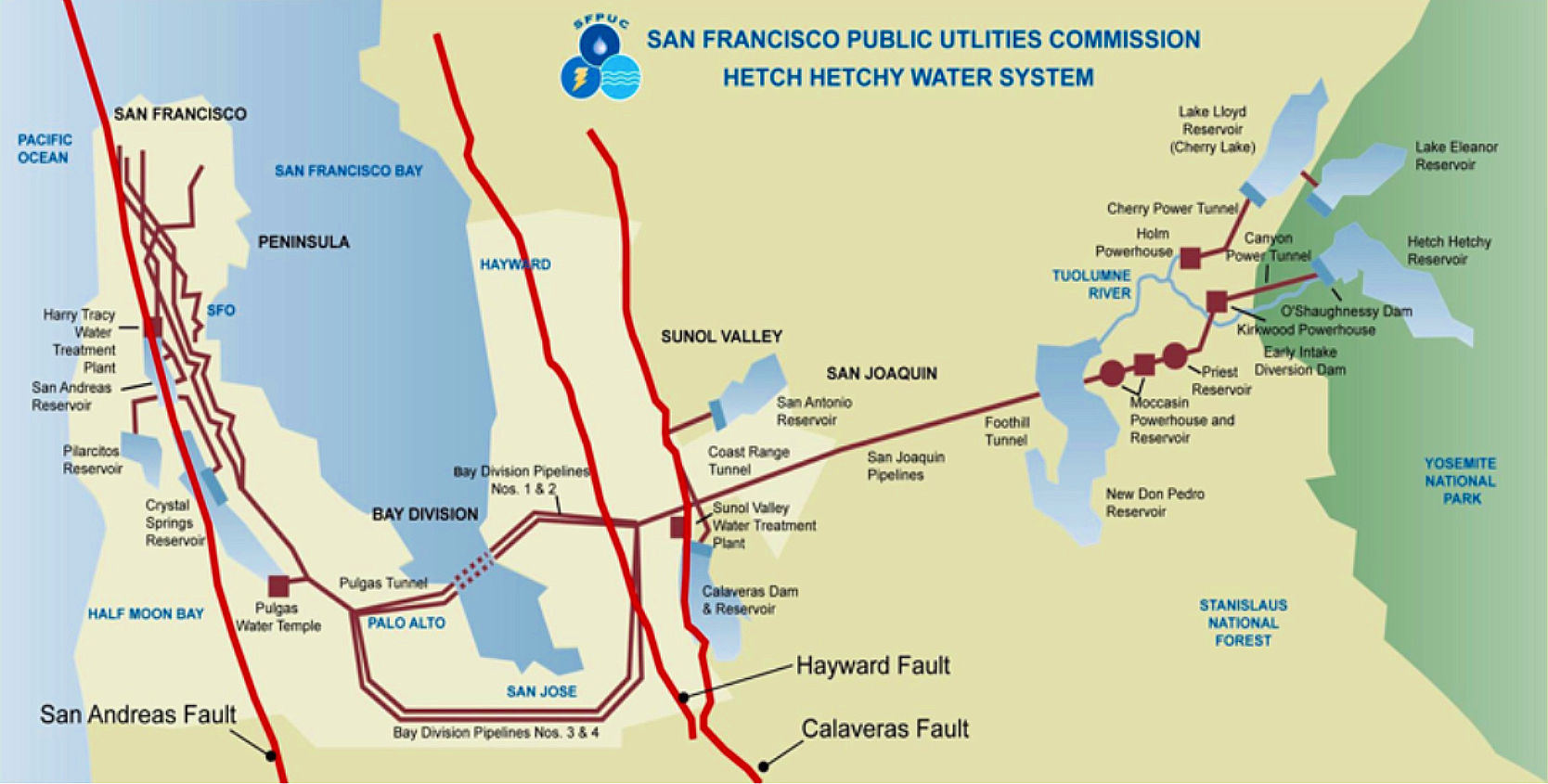
The San Francisco Bay Area’s water resources and the San Andreas, Hayward, and Calaveras earthquake fault lines.
Image: San Francisco Public Utilities Commission
The PUC’s drinking-water plan
Overview
The San Francisco Public Utilities Commission (PUC) manages two water systems: San Francisco’s drinking-water system and the AWSS high-pressure seawater system.
Drinking-water system
As of May 2026, Mayor Daniel Lurie and the City of San Francisco are planning to use San Francisco’s drinking-water system as the City’s emergency and post-earthquake firefighting water source.
AWSS high-pressure seawater system
Since 2010, the PUC has done nothing to expand the AWSS system across San Francisco. They have no current or future plans to do so.
Hetch Hetchy Water System
The Hetch Hetchy Water System provides drinking water for San Francisco and the Bay Area. The system’s water pipes (transmission mains):
Transport San Francisco’s drinking water 167 miles from the Sierra Nevada mountains;
Run across two major earthquake faults: the Calaveras Fault and the Hayward Fault;
Run below the San Francisco Bay;
Run along the San Andreas Fault, then end at three terminal reservoirs—Sunset, Merced Manor, and University Mound—in the southern areas of the City.
From a retired San Francisco fire official
Does it make sense to bet the lives of entire neighborhoods on an old, fragile drinking-water system that will immediately break during a 7.9M earthquake?
Since 2010, San Francisco voters have approved a total of $1.44 billion from three Earthquake Safety and Emergency Response (ESER) bonds.
As of 2026, the PUC has received $312.5 million for earthquake safety. They have used none of it on the AWSS system.
The PUC’s 2026 ESER bond plan states that Sunset Reservoir can be refilled within 24 hours after a major earthquake. However, based on firefighting analysis from 67 San Francisco fire officials, that statement is only speculation.
With ongoing fire disasters such as Santa Rosa, Lahaina, and Los Angeles, why does the City of San Francisco still:
Refuse to expand the AWSS system to all of San Francisco?
Refuse to use the Pacific Ocean as a firefighting resource?