Sound the Fire Alarm!
Thomas Doudiet, the Assistant Deputy Fire Chief of San Francisco from [DATE RANGE], is the former colleague and good friend of Assistant Fire Chief Frank Blackburn (1933–2025).
Doudiet wrote the following opinion article for The Sunset Beacon in 2017, as part of Blackburn’s and other activists’ lifelong efforts to get City Hall to listen to their warnings. His article is reprinted with the permission of richmondsunsetnews.com.
November 3, 2017
By Thomas W. Doudiet
As a 60-year resident of the Richmond District and a 32-year veteran of the SF Fire Department (SFFD), I have long been aware that the Outer Richmond and Sunset districts, with their hundreds of blocks of wood-frame buildings, will be highly vulnerable to fire immediately following the next great Bay Area earthquake.
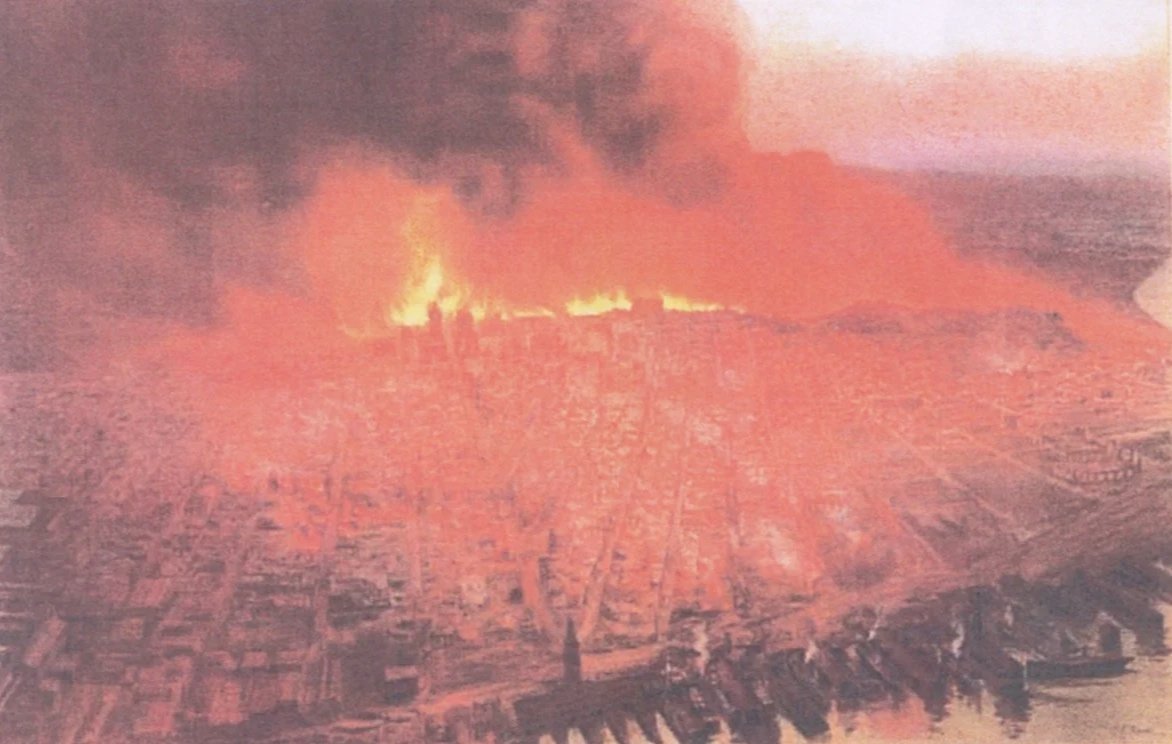
This image shows San Francisco in flames after a 7.8-earthquake struck in the early morning hours of April 18, 1906.
For many years while a member of the fire department, and for several years since my retirement in 2011, I have attempted, with little success, to alert city officials, including members of the SF Board of Supervisors and staff in the mayor’s office.
My message: There will be almost no emergency water supplies for the SFFD to use in these neighborhoods for fighting fires after the “big one” hits.
Why is this so?
There are two kinds of fire hydrants in San Francisco, the 9,000 small white low-pressure hydrants supplied by the same domestic water mains that supply water to every building in the City and the 1,600 larger hydrants with red, blue or black tops, supplied by the high-pressure mains of the Auxiliary Water Supply System (AWSS). This system was installed in the years following the 1906 earthquake and fire, mainly in the areas of the City that had been built up by 1913. Thus, it doesn’t exist west of 12th Avenue in the Richmond, west of 19th Avenue in the Sunset or in the city’s southern neighborhoods.
The seismically robust mains of the high-pressure hydrant system were built to withstand the effects of ground movement during an earthquake, whereas the domestic water supply that supplies both the low-pressure hydrants, as well as all of the city’s buildings, are not as seismically resistant.
These domestic mains, and many thousands of service connection water pipes leading from the mains into buildings, could break during a major seismic event. The result will be that the SFFD will have little or no water available from the low-pressure hydrants, just as happened in 1906.
In more than 15 neighborhoods of San Francisco, including the Bayview Heights, Crocker Amazon, Excelsior, Ingleside, Little Hollywood, Merced Manor, Mission Terrace, Oceanview, Outer Mission, Outer Richmond, Outer Sunset, Parkside, Portola, Sea Cliff, Stonestown and Sunnyside, there are no high-pressure hydrants, so how will SFFD firefighters stop the spread of fire from building to building and, soon thereafter, from block to block?
The simple answer is that they won’t. Conflagrations (fire storms), as occurred in 1906, will result.
How do we know there will be any fires? In addition to water service pipes going into every building in San Francisco, there are also natural gas pipes. Just as most of our domestic water mains are more than 100 years old, so are the gas pipes in many of these buildings. As we were shown in the Marina District in 1989, when building structures are disrupted, and sometimes collapse during an earthquake, ruptured gas lines are an explosive source of building fires.
Assuming that even one building in 1,000 develops an internal gas leak during an earthquake (there are approximately 56 residential buildings on an average block in the Richmond and the Sunset), let’s calculate the potential: there are about 225 square blocks in the Outer Richmond and about 525 blocks in the Outer Sunset – that is a total of 750 blocks times 56 buildings per block equals 42,000 buildings.
If we assume one gas leak per 1,000 buildings, there could be 42 simultaneous fires, in wood-frame buildings fed by natural gas leaks. Again, there will be no water in the existing low-pressure hydrants to fight these fires.
By the way, the 75,000 gallon cisterns that the City recently added to the Sunset (and a few in the Richmond) are good adjuncts to high-pressure hydrants, but they alone will not stop the fires following a large earthquake. Unless the use of water from a cistern to fight fires is very close to the fire, it would require two engines per cistern for firefighting, one at the cistern and one at the scene of the fire.
There are only 44 fire engines in San Francisco and only six engines assigned to cover both the outer Richmond and Sunset districts, possibly only enough to fight three fires using water from cisterns on the west side, and leaving perhaps as many as 39 fires burning unchecked.
Individual building fires that are not fought, especially in blocks of wood frame buildings with no space between them, could very soon lead to entire blocks on fire. The build-up of heat from many buildings burning simultaneously results in fire spreading from block to block by radiated heat, and the massive amounts of super-heated air rising creates a draft similar to a howling windstorm (eye-witness accounts of the fires after the 1906 earthquake vividly describe this process).
The entire southern and western parts of the city could be destroyed by fire in a single day following a major earthquake.
The point here is that unless the fire department has a ready source of water in a stable, high-pressure, high-volume hydrant system to use to fight individual small fires immediately after a large earthquake, entire neighborhoods will be destroyed.
As difficult as it is to consider, people trapped in collapsed buildings that are in the path of a conflagration are not likely to be rescued before they, too, are consumed by the flames.
In 2010 and again in 2014, San Francisco voters approved the so-called Earthquake Safety and Emergency Response (ESER) Bonds. Literature published in support of the ballot propositions in the Voter’s Guide by the SF Chamber of Commerce and SF Democratic Party implied the AWSS extensions of the high-pressure hydrant system into the outer Richmond and Sunset districts were going to be funded by these and subsequent bonds.
Following the passage of the 2014 ESER bond measure, however, a strange thing occurred. In spite of the published reports and recommendations of the engineering firm the City hired to study fire protection issues, the SF Water Department (an arm of the SF Public Utilities Commission) clearly signaled that it no longer intended to go forward with the extension of this hydrant system into our neighborhoods after all.
This change in plans became apparent when they moved to auction off, for scrap metal prices, millions of dollars worth of materials and parts that the City had stored for the purpose of repairing and extending the high-pressure hydrant system. The water department’s actual intent then became clear: despite what voters had been led to believe, the water department now has absolutely no intention of actually extending the high-pressure hydrant system into the outer neighborhoods.
In April 2016, SF Supervisor Aaron Peskin, chair of the supervisors’ Government Audit and Oversight Committee, held a hearing to determine whether the auctioning off of these parts by the water department made sense, in view of the city’s publication, just before the 2014 bond issue, of maps showing the proposed extension of the high-pressure hydrant system into the outer Richmond and Sunset districts and other neighborhoods.
Representatives of the water and fire departments were asked to explain to the supervisors why, if they intended to extend the system into currently unserved neighborhoods, they would be selling off the necessary parts as scrap metal.
The answer given by both a water department manager and a uniformed member of the SFFD’s command staff was that they now believed that these hydrants were not needed.
Instead, they said, they had discovered that they could purchase 15 miles of large diameter hoses that could be dropped from the back of flatbed trucks, as needed, following a major earthquake. This, they stated, would enable the fire department to fight the expected fires and save those neighborhoods, without high-pressure hydrants, from being destroyed by conflagrations.
To say that this bizarre scheme defies common sense is an extreme understatement:
They had no experience using this type of hose, even in daytime simulations under optimum conditions;
They had no plan for where the hose and these trucks would be stored;
They had no plan for who would drive the trucks (later, it was proposed the Neighborhood Emergency Response Team (NERT) volunteers would do the job);
They proposed using capital bond money to purchase the hose, despite the illegality of doing so;
They had no explanation as to how the trucks would maneuver around earthquake debris in the streets, possibly in total darkness and without electricity;
They could not explain how incipient fires could be fought without any water, nor who would be rescuing people trapped in damaged buildings, while firefighters were occupied setting up flexible hoses;
They had no explanation as to how they would avoid having these same huge hoses overrun by the conflagrations that would have developed from the merging of the many incipient fires that would be left unchecked during the hours that all this elaborate process was taking place.
Obviously, the large-diameter hose premise put forth by the water department, and which the uniformed SFFD command staff member clearly and heartily endorsed, was an absurdly adolescent exercise in trying to cover their folly in abandoning the extension of the high-pressure hydrant system into the outer neighborhoods where it has never been installed.
Fortunately, the flexible hose scheme has been abandoned.
There is no dependable high-pressure and high-volume source of emergency water for post-earthquake firefighting in the outer neighborhoods, and therefore it is entirely accurate to say: The SFFD has no viable plan for extinguishing post-earthquake fires in outlying areas of the City.
As it stands now, 15 neighborhoods are exposed and will very likely be destroyed by fire following the next big Bay Area earthquake, and, neither the water department nor the fire department has any coherent plans to mitigate this situation!
If this intolerable level of official negligence on the part of the water an fire departments is not corrected, you and I and most of our neighbors will very probably lose our homes and businesses to fires after a big earthquake.
After all has been destroyed, the blame will be squarely on the management of water and fire department officials. The best that can be said for these “public servants” is that they are guilty of gross professional incompetence; the worst is that their refusal to address this issue borders on criminal negligence.
If they will not live up to their professional responsibilities, they must be relieved of their duties and replaced with competent people who will.
Our district supervisors and the mayor must be put on notice that the residents of the city’s southern and western districts will no longer tolerate this egregious indifference to our personal safety and the safety of our homes and businesses. Let them know that we rightfully expect the extension of the high-pressure hydrant system into the outer neighborhoods. Our homes, businesses and the safety of our families will someday depend on it.
Thomas W. Doudiet is a retired assistant deputy chief with the SF Fire Department.